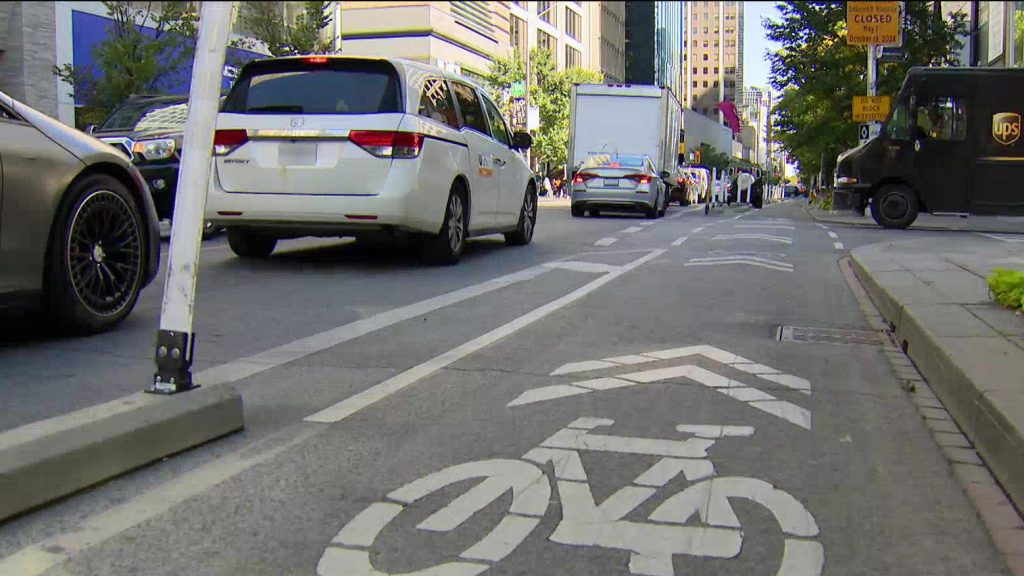
Premier Doug Ford's plans to remove bike lanes and reconfigure streets in Toronto are currently in progress, igniting a contentious debate regarding the city's cycling future. On Saturday, numerous cycling advocates took to the streets—not only along the protected bike lanes on Bloor Street but also on the secondary roads that Ford aims to redirect cyclists to.
Michael Longfield, executive director of Cycle Toronto, emphasized the importance of the existing bike lane placements: “There’s a reason why the City of Toronto builds bike lanes where they do; Bloor, Yonge, and University have been voted on multiple times by city council under various mayors.” He pointed out that the decision-making process for these lanes was not a unilateral action by Mayor Olivia Chow but a collective decision by the city council.
The detour through the west end of the city, which avoided bike lanes, transformed what should have been a brief and straightforward ride along Bloor into a nine-kilometer route filled with elevation changes, resulting in cyclists overtaking adjacent lanes of traffic. One participant reported, “We were going through schools, we were going up these crazy hills. It was nearly double the distance. Trying to do this on a day-to-day basis would be nearly impossible.” There were even incidents during the rally, including a child sustaining an injury after falling into a ditch, demonstrating that side streets lack the necessary infrastructure for safe cycling.
The controversy surrounding Premier Ford's proposal to eliminate nearly 20 kilometers of protected bike lanes on key thoroughfares like Yonge Street, Bloor Street, and University Avenue faced legal challenges last summer. Although an Ontario court initially blocked the plan, the Ontario Court of Appeal reversed that decision in August, which had previously determined that the plan posed an unconstitutional risk to cyclist safety. Cycling advocates expressed disappointment over this ruling, asserting that the removal of bike lanes would endanger lives.
Numerous cyclists articulated their concerns regarding safety and the detrimental effects of removing bike lanes. One cyclist shared, “Cars have their space, I have my space. Without the bike lanes, I would not have had the courage to be cycling in Toronto. Before, I thought it was suicidal." Others noted the significant impact that bike lanes have on pedestrian safety as well due to related traffic calming measures.
In light of the tense situation, Mayor Olivia Chow has presented the province with an alternative plan that aims to restore traffic lanes without sacrificing protected bike lanes. However, the provincial government has dismissed this proposal and ceased negotiations. Alex Gilmour, NDP MPP for Parkdale-High Park, echoed the sentiments of many advocates by urging Ford to “stay in your lane,” insisting that the municipal government is adequately handling these local matters.
Ford has voiced concerns about bike lanes contributing to traffic congestion, referencing a study from the Canadian Centre for Economic Analysis that attributed $56 billion in annual costs to gridlock in Ontario. Recently, the province issued a request for proposals (RFP) aimed at studying potential design options for restoring vehicle lanes on several major streets, including Bloor Street, University Avenue, and Avenue Road. The RFP also seeks to identify possibilities to retain or reconfigure existing bike lanes “where they make sense and do not worsen gridlock,” according to provincial statements.