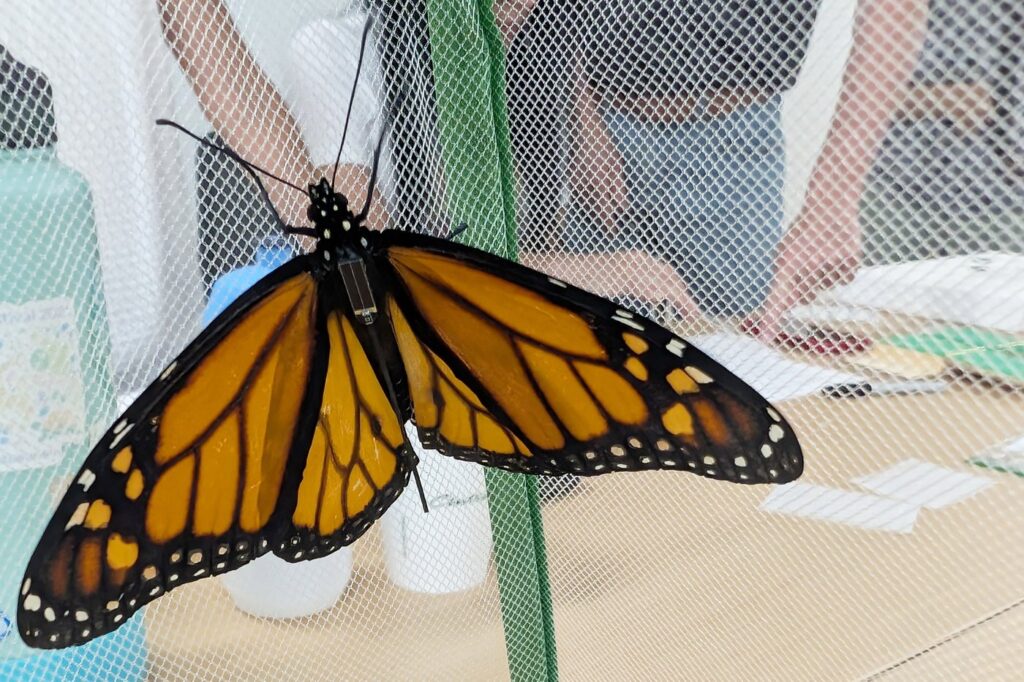
As a child, Rebeca Quiñonez-Piñón was curious about where monarch butterflies pause for nourishment and rest during their extensive migrations across North America. Today, she leads a team of scientists who are equipping hundreds of these butterflies with tiny tracking devices to identify essential stopover areas that are at risk of vanishing.
These magnificent orange-and-black monarchs navigate roughly 3,000 miles (4,800 kilometers) from locations as far north as southern Canada to winter in oyamel fir forests located in central Mexico, a UNESCO World Heritage site that serves as a protected biosphere reserve.
Despite significant interest in understanding their migration patterns, scientists have faced challenges in accurately mapping the butterflies' routes, daily travel distances, and resting spots. However, by utilizing solar-powered radio tags on nearly 1,750 monarchs this year, researchers are beginning to uncover the answers to these questions.
With monarch populations facing immense threats from habitat loss, pesticides, and climate change, the findings from this ongoing research could play a pivotal role in reversing this decline. Quiñonez-Piñón emphasized that the iconic monarch butterfly serves a vital purpose in raising awareness about the precarious situations insects encounter and their essential function in maintaining plant life across the continent. She stated, “Pollinators are crucial to protect and ensure that our ecosystems remain healthy, and also to have the sources of food that we require as humans.”
The public can track the movements of tagged butterflies via the free app called Project Monarch Science.
Quiñonez-Piñón, who serves as the senior scientist at the National Wildlife Federation, is collaborating with a tri-national science team to enhance the understanding of where monarchs stop in Texas, particularly in the so-called "Texas funnel." While not all monarchs undertake migration, a significant number of those residing east of the Rocky Mountains travel through this migration corridor each fall and spring as they head north to lay eggs before dying.
Each year, the exact regions that these butterflies prefer may vary based on the availability of water, nectar, and overnight shelter such as trees. Since tracking efforts commenced last year, researchers have identified evidence of the migration paths of eastern monarchs venturing into states like Utah, as well as others traversing the Eastern Seaboard to Florida and further into Mexico. Such connections were previously unknown.
Emma Pelton, a senior conservation biologist with the Xerces Society for Invertebrate Conservation, expressed excitement about the new revelations, noting, “There are just all these unique stories of their paths, connections between the population, that we didn’t know existed or we hypothesized but couldn’t prove.”
As of now, around 175 tagged butterflies have been successfully detected in Mexico since the migration began this year. The new tracking devices, costing $200 each, have been specially designed to be extremely lightweight—on par with a drop of water—by Cellular Tracking Technologies. Quiñonez-Piñón stressed that if a trained individual attaches the device correctly, it will not harm the butterfly.
However, not every monarch is suitable for tagging; researchers typically choose butterflies weighing over 400 milligrams, which is comparable to the weight of a standard pill. Some captured monarchs are temporarily stored in cool environments to keep them calm before the tagging process, which demands precision and care.
Louie Yang, an insect ecologist at the University of California, Davis, remarked on the significance of this technology, noting, "We haven't previously been able to see what path they take or how quickly they're moving over different parts of that journey." He also mentioned the limitations of this technology, as it doesn't provide exact locations of the butterflies, but rather indicates where receivers detected them, with no guarantee of their survival.
The life span of monarchs is typically between two and six weeks, yet those migrating to Mexico can live for up to nine months, navigating southward through winter and returning north to breed in the spring. This impressive migration has made the monarch a symbol of international migration rights.
Nonetheless, the population of eastern monarchs has plummeted by over 80% since the mid-1990s, while western populations have faced a staggering 95% decline. The use of pesticides threatens milkweed, the sole food source for caterpillars and a necessary plant for egg-laying. Climate change, exacerbated by the burning of fossil fuels, poses additional threats, as altered weather patterns impact migration cues and seasonal changes.
The loss of nectar-producing plants due to drought, road mortality from vehicles, and habitat destruction for development further exacerbate the challenges faced by these butterflies. Although the Trump administration delayed a decision regarding federal protections for monarchs, a court has mandated that a final ruling must be made by 2030.
Despite these obstacles, conservationists are actively seeking innovative methods to protect the vulnerable monarch population. In Texas, nets have been installed along certain highways to help butterflies fly higher and avoid collisions, particularly during nighttime roosting. Efforts to promote the planting of milkweed and other pollinator-friendly plants in gardens, along roadsides, and transportation corridors are also showing promising results in boosting local populations.