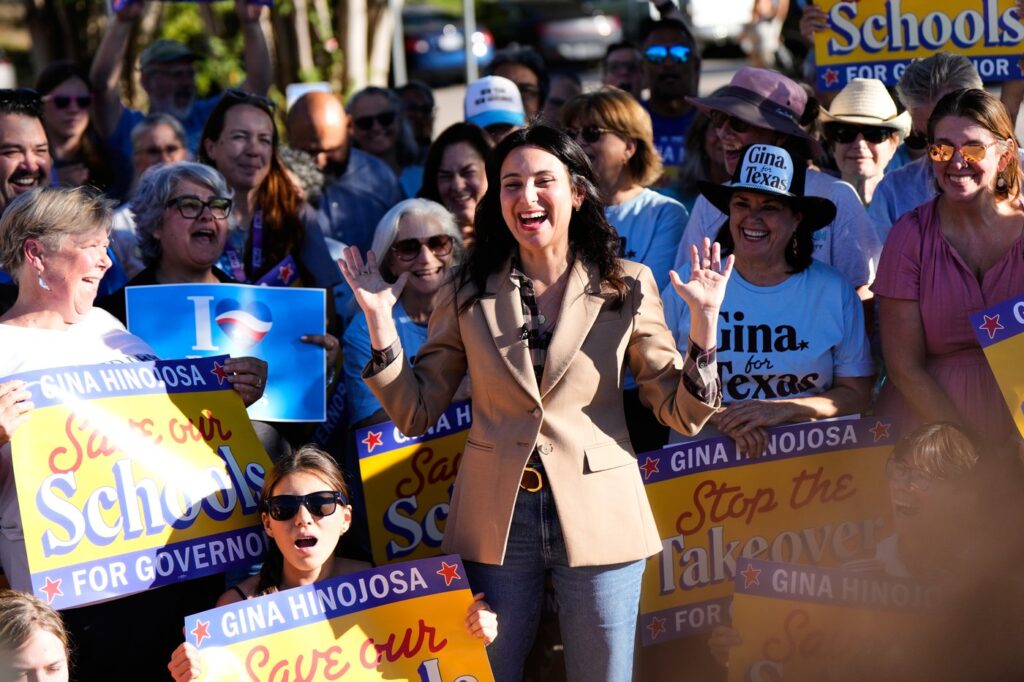
AUSTIN, Texas (AP) – In a remarkable political turnaround, Gina Hinojosa was elected as Texas' first Democratic governor in over three decades, defeating Republican incumbent Greg Abbott in a stunning upset on Tuesday. This victory positions Hinojosa, a state legislator from Austin, as a significant figure in the evolving Democratic landscape of the traditionally red state.
At 52 years old, Hinojosa will not only be the first Latina governor of Texas but also the first Democrat to assume the governorship since Ann Richards in the 1990s. Her win symbolizes a critical shift in Texas politics, suggesting that demographic changes within the state could lead to a transformation in the political power dynamics, making Texas a potential battleground in future elections.
Hinojosa's election was part of a broader successful night for Democrats in Texas, during which James Talarico also won a seat in the U.S. Senate over Republican Ken Paxton. Her victory is seen as a testament to the long-held belief among Democrats that changing demographics in Texas would eventually alter the political landscape. Despite facing skepticism and limited support from the national party, Hinojosa catapulted herself into national prominence.
Addressing her supporters at her victory celebration, Hinojosa expressed her dedication to the Texas population, stating, "It never bothered me that they doubted me. It bothered me that they doubted us. Texas, my faith in you never wavered." Starting her campaign with minimal funds and recognition, Hinojosa focused on grassroots efforts, critiquing Abbott's policies and the growing influence of artificial intelligence data centers in Texas.
Throughout the campaign, Hinojosa emphasized her populist message, advocating for working-class Texans and promising a one-time $1,500 payment to nearly 32 million residents, which she termed a "Corruption Tax Refund." This would be funded by Texas' sizeable emergency savings fund. In response to Abbott's previous actions, she passionately spoke against the unchecked expansion of energy-intensive data centers, which resonated with public concerns over resource management.
Despite her progressive roots, Hinojosa strategically distanced herself from the progressive label, seeking to appeal to a broader voter base, including Republican supporters who felt alienated by Abbott's administration. Her campaign focused on economic issues rather than cultural controversies, countering Abbott’s claims that she would raise taxes and threaten the Texans' way of life. Hinojosa asserted, "They want to run an entire campaign saying that I’m too woke. I plan to spend an entire campaign focused on the fact that working people are too broke."
The outcome of this election raises concerns among Republicans nationally, particularly as they rely on Texas' electoral votes to maintain a viable path to the White House in presidential elections. Abbott, who has been in office since 2015 and has won his previous races by significant margins, faces a new political landscape as Hinojosa's electoral success reflects a potential change in voter sentiment and priorities in the state.
Hinojosa's governance will likely introduce significant changes in the Texas Capitol, where Republicans have maintained control over the past decade, enacting strict abortion laws and immigration policies that have stirred controversy. As she takes office, the extent of her influence will be tested in a legislative environment dominated by Republican lawmakers.
Hinojosa's victory marks a pivotal moment in Texas politics, representing not only a personal triumph but also an indication of shifting political tides in a state that has long been seen as a Republican stronghold.