NEW YORK (AP) – Incoming Mayor Zohran Mamdani will mark a historic moment in New York City's political landscape by taking his midnight oath of office on a centuries-old Quran. This event signifies the first time a New York City mayor will be sworn in using Islam’s holy text and highlights a series of historic firsts for the city, as Mamdani represents multiple milestones in the realm of diversity.
At just 34 years old, Mamdani, a Democrat, will enter office in a long-closed subway station beneath City Hall, making him the first Muslim mayor, the first South Asian mayor, and the first African-born individual to assume this role. These accomplishments, combined with the historic Quran chosen for the ceremony, underscore the rich tapestry of Muslim communities within New York City, as emphasized by a scholar who assisted Mamdani’s wife, Rama Duwaji, in selecting the religious texts.
Traditionally, many of Mamdani’s predecessors were sworn in using a Bible; however, the oath to uphold the federal, state, and city constitutions does not mandate the use of any specific religious text. During his campaign, Mamdani has placed significant emphasis on the issue of affordability in New York City, while also being vocal about his Muslim faith. He often attended mosques across the five boroughs, working to garner support from South Asian and Muslim voters, many of whom were first-time participants in the electoral process.
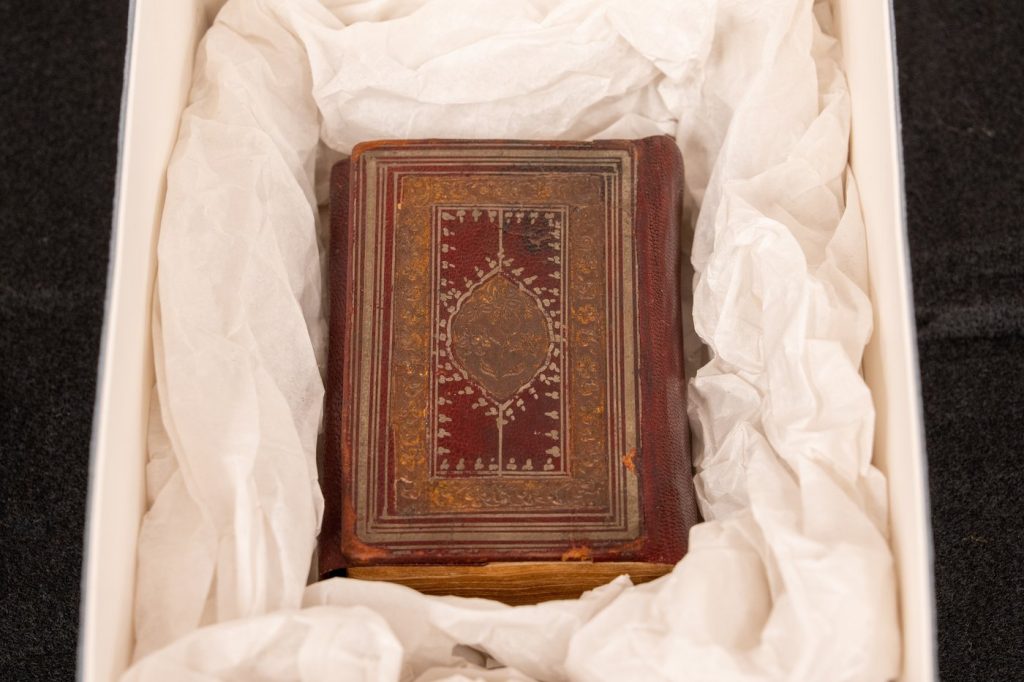
Mamdani’s swearing-in ceremony will involve the use of two Qurans: his grandfather’s Quran and a pocket-sized Quran, believed to date back to the late 18th or early 19th century. This copy is part of the collection housed at the New York Public Library’s Schomburg Center for Research in Black Culture. Hiba Abid, the library’s curator for Middle Eastern and Islamic Studies, affirmed that this particular Quran encapsulates the diversity and historical depth of the city’s Muslim population.
Abid elaborated that while the Quran may be small, it embodies significant themes of faith and identity intertwined within the history of New York City. Mamdani plans to use both his grandfather’s and grandmother’s Qurans for a subsequent ceremony at City Hall on New Year’s Day. However, further details regarding these heirlooms have yet to be disclosed by the campaign.
The Quran chosen for the ceremony holds a notable provenance. It was acquired by Arturo Schomburg, a distinguished Black Puerto Rican historian committed to documenting the global contributions of individuals of African descent. Although it remains unclear how Schomburg obtained the Quran, scholars speculate that it reflects his engagement with the historical ties between Islam and Black cultures in both the U.S. and Africa.
Distinct from elaborate manuscripts typically associated with royalty or the elite, the form of the Quran that Mamdani will utilize is simplicity itself. Its deep red binding features a modest floral medallion, and the text is inscribed in black and red ink. Its straightforward script indicates a practical purpose, suggesting it was intended for everyday readers rather than ceremonial use, a quality that Abid highlighted as central to its meaning.
Scholars estimate that the manuscript was crafted during the late 18th or early 19th century in a region that comprises present-day Syria, Lebanon, Israel, the Palestinian territories, and Jordan, relying on its binding and script to make this assessment. Abid stated that the Quran’s journey to New York parallels Mamdani’s own complex heritage, as he is a South Asian individual born in Uganda, while Duwaji is of American-Syrian descent.
The rapid rise of a Muslim democratic socialist figure encountered an increase in Islamophobic discourse, exacerbated by national media attention on his candidacy. In a deeply resonant speech shortly before the election, Mamdani expressed that the hostility surrounding his campaign only reinforced his commitment to being open about his faith, stating, “I will not change who I am, how I eat, or the faith that I’m proud to call my own.” He vowed to embrace his identity and presence rather than hiding away.
The decision to utilize a Quran during the ceremony has sparked criticism from conservative groups, such as U.S. Senator Tommy Tuberville from Alabama, who posted on social media that “the enemy is inside the gates” in response to news regarding Mamdani’s inauguration. The Council on American-Islamic Relations (CAIR), a civil-rights organization, has labeled Tuberville as an anti-Muslim extremist based on his past remarks.
Such backlash is reminiscent of the experiences faced by Keith Ellison, who became the first Muslim elected to Congress in 2006 and similarly encountered fierce opposition after opting to use a Quran for his ceremonial oath. Following Mamdani’s inauguration, the Quran is set to be displayed publicly at the New York Public Library, with Abid expressing hopes that the ceremony’s spotlight—regardless of the mixed reactions it garners—will inspire more individuals to explore the library’s resources detailing Islamic life in New York, ranging from early 20th-century musical recordings to personal narratives addressing Islamophobia post-September 11 attacks.
Abid emphasized the significance of the manuscript being shared with the public, noting, “This manuscript was meant to be used by ordinary readers when it was produced; today it lives in a public library where anyone can encounter it.”