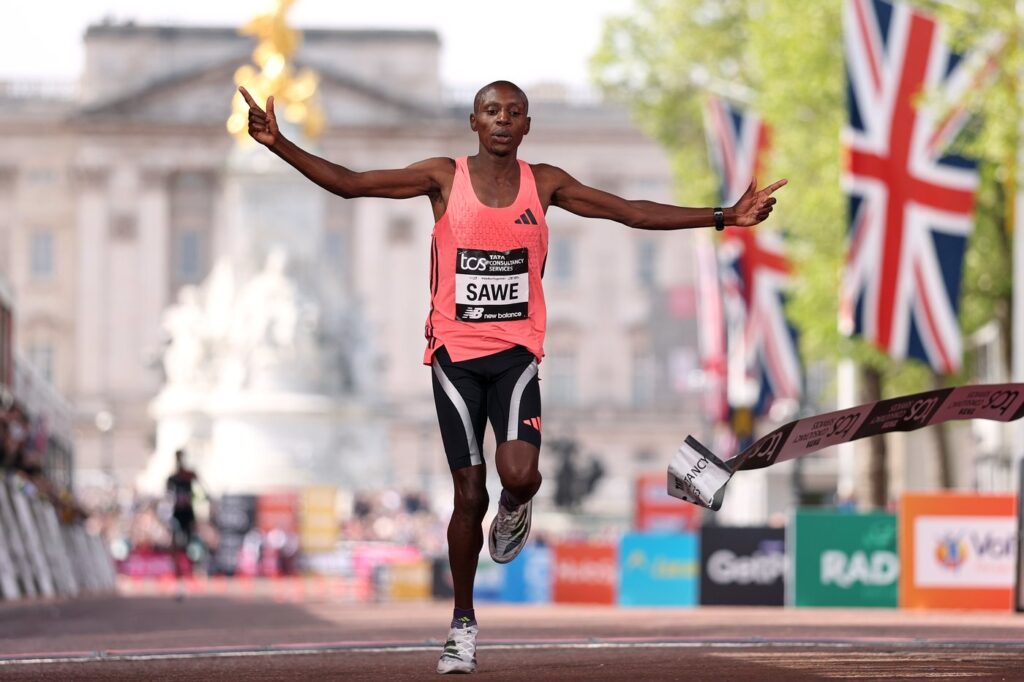
LONDON (AP) — In a historic achievement on Sunday, two African distance runners made headlines by breaking the seemingly insurmountable two-hour barrier for the marathon, completing the 26.2-mile (42.2-kilometer) race in record time. Sabastian Sawe of Kenya triumphed at the London Marathon, finishing with an astounding time of 1 hour, 59 minutes, and 30 seconds. This remarkable accomplishment improved the previous men's world record by 65 seconds.
Following closely behind, Ethiopia's Yomif Kejelcha finished his first marathon in a commendable time of 1:59.41. Sawe expressed his joy, stating, "What comes today is not for me alone, but for all of us today in London." Meanwhile, Jakob Kiplimo of Uganda secured third place with a finish time of 2:00.28, marking a significant moment in marathon history as all three podium finishers eclipsed the previous world record set by Kenya’s Kelvin Kiptum.
The London Marathon's flat terrain and ideal weather conditions, with temperatures in the low 60s (15 Celsius), facilitated Sawe's historic run. He posted an impressive time of 59:01 for the second half of the race, pulling away from Kejelcha after the 18.5-mile (30-kilometer) mark before making a solo sprint towards the finish line.
Sawe, who had returned as the defending champion at the London Marathon, credited the enthusiastic crowd for their support during the race. "I think they help a lot because if it was not for them you don’t feel like you are so loved... with them calling, you feel so happy and strong," he said, reflecting on the energy of the thousands who lined the streets to witness the historic moment.
While breaking the two-hour marathon mark has been a long-standing goal for elite runners, the feat had previously occurred in an unofficial setting. Notably, Eliud Kipchoge of Kenya completed the marathon in under two hours in 2019 during a specially organized event but did not receive official recognition due to controlled conditions. Sawe's record-breaking performance officially places him in the history books, having lowered that time by 10 seconds.
Paula Radcliffe, a former London Marathon winner, commented on the significance of this achievement, noting, "The goalposts have literally just moved for marathon running." The evolution of marathon running has seen remarkable advancements over the years, with the first sub-2:30 marathon being recorded in 1925 and subsequent barriers being shattered over the decades. The world record for the men’s marathon had previously been set at 2:05:42 by Khalid Khannouchi in 1999.
In addition to Sawe's record, the race also featured breakthroughs among women runners, with Ethiopia’s Tigst Assefa winning in 2:15:41, marking the fastest-ever time in a women’s-only marathon. Although slightly slower than the overall course record of 2:15:25 set by Radcliffe in 2003, her win represents a significant moment in female distance running.
Assefa's victory saw her finish 12 seconds ahead of Kenya’s Hellen Obiri, who achieved a personal best, with Joyciline Jepkosgei finishing third. Notably, this race marked the first occasion where three women completed the marathon under 2:16, highlighting the growing competitiveness in women’s distance running.
The wheelchair races also showcased exceptional performances, with Switzerland's Marcel Hug claiming his sixth consecutive men’s title and Catherine Debrunner defending her women's title in a narrow win against Tatyana McFadden.
Overall, the London Marathon on April 26, 2026, not only set new standards for marathon running but also exemplified the remarkable evolution of athletics, spurred by advancements in training, nutrition, and cutting-edge footwear technology. Sawe's and Assefa's landmark achievements will be remembered as pivotal moments in the history of the sport.