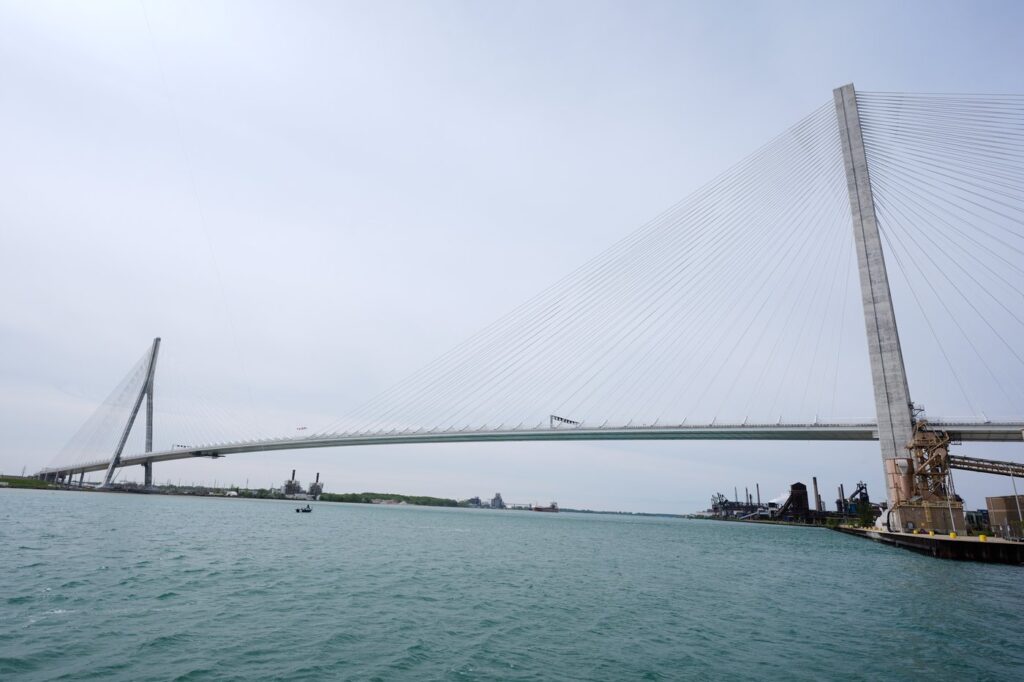
OTTAWA – Conservative Leader Pierre Poilievre is calling on Prime Minister Mark Carney to provide more transparency regarding the agreement made with the Trump administration concerning the Gordie Howe International Bridge. Poilievre's demands were conveyed in a letter posted on social media, where he stated, “It's time for you to release the deal so Canadians can see for themselves what you negotiated away to the Americans.”
Carney sparked confusion regarding the specifics of the deal when he addressed reporters on Thursday. He stated that any sharing of toll revenue would not take place until all construction debts associated with the bridge were repaid. However, Carney contradicted himself by also mentioning that Canada and the U.S. would share net revenues—after operational costs—over the upcoming 15 years.
A report by Bloomberg news on Friday indicated that the deal lacks provisions for covering debt servicing costs. Under this agreement, the U.S. portion of the revenues will contribute to a regional economic development program in Michigan, while Canada can utilize its share to pay off the construction debts.
A senior Canadian government source, who spoke off the record, confirmed the details reported by Bloomberg. The 15-year agreement to open the bridge, which connects Michigan and Ontario, is distinct from the prior deal made by Ottawa in 2012. The original agreement, signed with former Republican Michigan governor Rick Snyder, will remain effective, with all toll revenues directed to Canada for the first 15 years until the full construction costs are settled. After that period, toll revenues will be divided with Michigan.
Ownership of the bridge is shared between Michigan and the Government of Canada. The recent deal with the Trump administration, announced suddenly on July 27, has resulted in varied interpretations from Ottawa, the White House, and Michigan Republicans regarding its actual terms.
A ribbon-cutting event had been planned for June 12 to inaugurate the $6.4-billion bridge; however, U.S. Commerce Secretary Howard Lutnick reportedly intervened, causing delays. Subsequently, Lutnick, along with U.S. Ambassador to Canada Pete Hoekstra, took the reins in renegotiating the agreement.
The situation surrounding the bridge took a complicated turn in February when Lutnick met with a member of the Moroun family, known for their long-time Republican support and ownership of the competing Ambassador Bridge. This meeting coincided with U.S. President Donald Trump’s social media declaration, in which he threatened to block the bridge's opening unless the United States received compensation.
After the revised agreement was finalized, Trump took to social media to assert that he had secured a “better deal” for the United States. He said, “I was able to cut a MUCH BETTER DEAL for America, and by so doing, will be allowing the new and spectacular Gordie Howe International Bridge, spanning Detroit and Windsor, Ontario, to open on July 27th, as scheduled.”
This report highlights the turbulent dynamics surrounding international infrastructure agreements and the differing national interests at play, especially in the realm of cross-border relations.