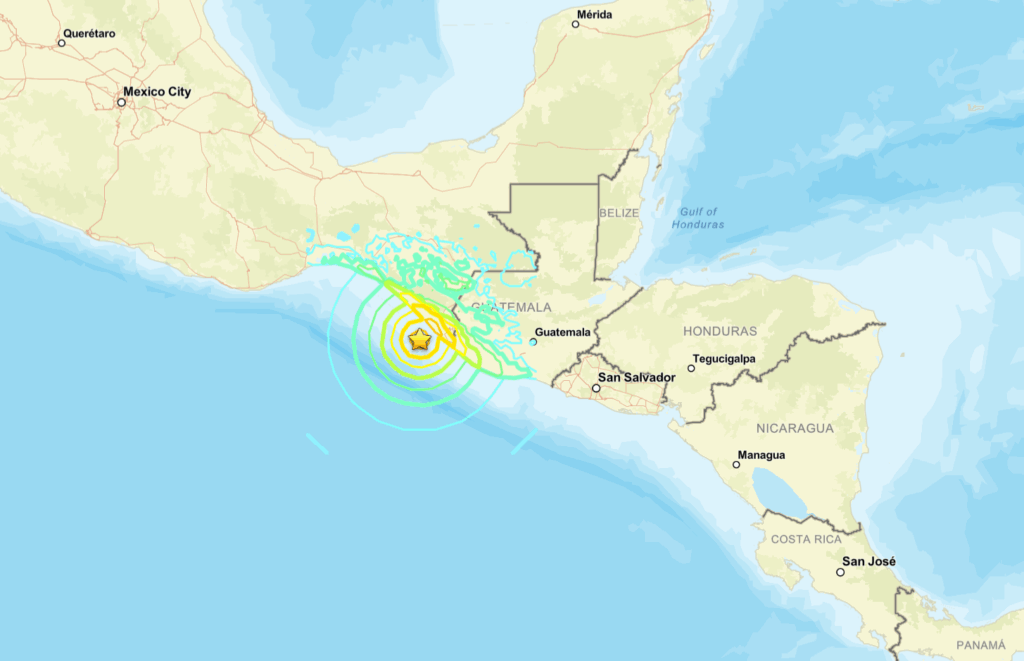
TAPACHULA, Mexico (AP) — A powerful earthquake with a magnitude of 7.3 struck the southern Mexican Pacific coast on Friday, close to the border with Guatemala. The tremor, which occurred at an epicenter located 48 kilometers (30 miles) southwest of Aquiles Serdan in Chiapas, was felt across a wide area from Mexico City to El Salvador. Fortunately, authorities reported no significant damages or casualties, aside from two individuals injured in southern Mexico.
The U.S. Geological Survey (USGS) reported that the earthquake occurred at a depth of 15 kilometers (9 miles) and was preceded by a smaller quake out in the ocean. Following the main shock, at least 10 aftershocks were recorded, ranging in magnitude from 4.9 to 6, indicating continued seismic activity in the region.
As the tremor began mildly in Tapachula, the main city on Mexico's southern border, it gradually intensified. Alejandra Mendoza, an administrative employee at a public hospital, recounted the experience, stating, "We were upstairs on the second floor when it started shaking; we thought it would pass, but then it got stronger, so we all went downstairs and evacuated in an orderly manner to the front courtyard."
Demetrio Martínez, head of the city’s Civil Protection agency, provided updates on the aftermath. He reported that a Haitian migrant woman in her 30s suffered a nervous breakdown and leaped from a height of approximately four meters (13 feet) from her apartment building. She was hospitalized with fractures, though her life was not at risk. Additionally, there was a minor injury reported from a broken window at a nearby business.
In Guatemala City, the earthquake provoked anxiety among residents due to its duration. Many individuals rushed into the streets as the tremor coincided with the start of the workday, leading to several building evacuations. The National Coordinator for Disaster Reduction (CONRED) of Guatemala stated that there were no immediate reports of damage, although social media users shared footage of landslides, particularly along roads running westward.
The earthquake's impact led the Ministry of Education in Guatemala to suspend in-person classes in the departments of San Marcos, Quetzaltenango, Suchitepéquez, and Retalhuleu, which are located near the quake's epicenter. Meanwhile, in Mexico City, buildings shook and creaked; however, the government indicated that the earthquake alert system did not activate since the energy radiated by the quake did not exceed the necessary thresholds for activation.
Mexican President Claudia Sheinbaum announced that preliminary reports indicated no significant damage. However, the navy advised the public to stay away from beaches for six hours due to a potential tsunami risk. The Meteorological Service of Chiapas further warned that tsunami waves of up to 1 meter (3.3 feet) could occur off the coasts of both Mexico and Guatemala. Monitoring for tsunami risk was particularly emphasized in the town of Suchiate, situated along the border river separating the two nations, according to Mayor Elmer Vázquez Gallardo.
In San Salvador, the earthquake was also felt intensely, but there were no reports of deaths or damages. The Ministry of Environment noted an additional smaller quake off the eastern coast near Usulután shortly after the larger tremor. This region is known for its seismic activity, having experienced deadly earthquakes in the past. Earlier this year, a significant earthquake rocked southern and central Mexico, resulting in two fatalities, while a 7.1 magnitude earthquake in 2017 claimed hundreds of lives in Mexico City.