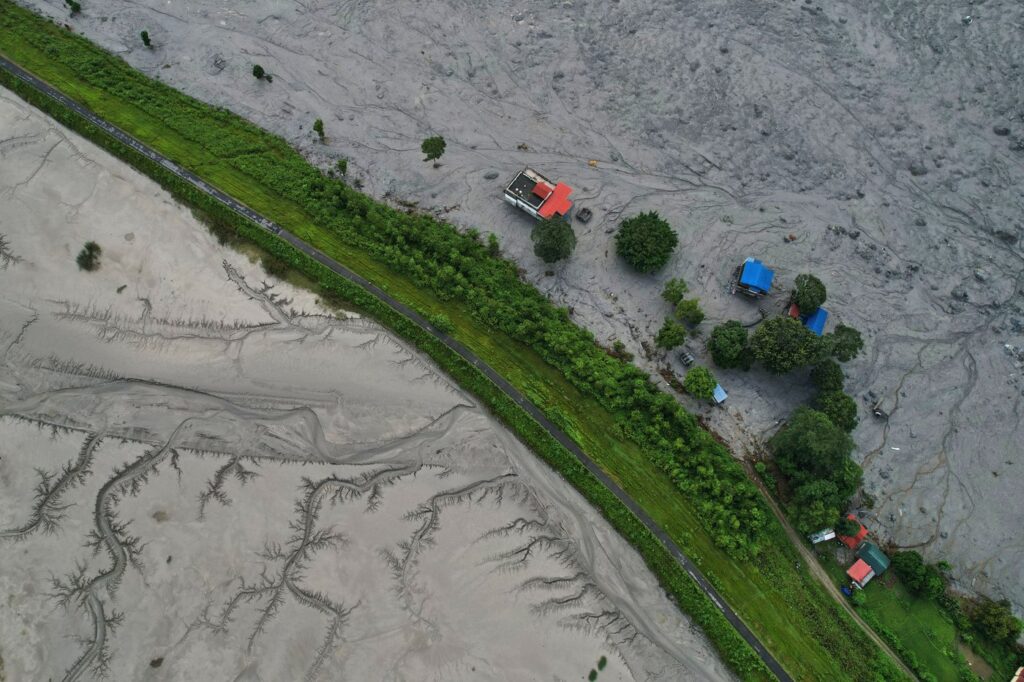
KATHMANDU, Nepal (AP) On Monday, rescuers hurried to free hundreds of workers trapped in hydropower project tunnels that were buried by devastating floods along the Nepal-China border. The disasters have led to a rising death toll, with frantic families seeking missing loved ones.
The combined fatalities in Nepal and China exceeded 950, and more than 4,400 individuals were reported missing. The Independent Power Producers’ Association of Nepal announced that at least 900 workers are unaccounted for at twelve hydropower sites affected by flash floods in Nepal's Rasuwa and Nuwakot districts.
Approximately 500 of those workers are believed to be trapped within tunnels. Some experts indicated that while some may have access to oxygen, the chances of finding survivors are rapidly decreasing. As the search efforts intensified, four bodies were recovered from mud-filled tunnels, according to the Nepal Army.
On the day the disaster struck, which was last Wednesday, some workers managed to call for help, and others who managed to escape reported that many colleagues remained trapped inside. Mohan Kumar Dangi, president of the Independent Power Producers’ Association, revealed that the situation was dire, with fears growing that some workers might have suffocated.
The rescue operations are focused on the enormous tunnels designed to control water flow. Geoscientist Jakob Steiner from the University of Graz in Austria noted that these tunnels are large enough for truck traffic, and efforts to provide oxygen for trapped individuals are underway. However, urgent concerns regarding food and water availability persist.
Within the Upper Trishuli-1 Hydropower Project in Rasuwa, 576 individuals are reported missing, with about 300 presumed trapped inside the project's tunnel. In the Trishuli-3 Hydropower Project, rescue crews are working to descend 15 meters (50 feet) into a tunnel in pursuit of those thought to be trapped.
Meanwhile, on the Chinese side, recovery efforts included repairing roads leading to the Gyirong Port border crossing, which facilitates travel between China and Nepal. State media displayed images of trucks transporting large rocks for road repaving, alongside swiftly flowing waters heightened by ongoing rainfall. The road is currently submerged under 2 to 3 meters (6.6 to 9.8 feet) of water.
Despite some rescue teams managing to access the border area, this represented only a small fraction of the overall rescue force. Coverage by Chinese state media mainly highlights governmental actions and the deployment of emergency personnel, with little information available regarding victims in China.
In Nepal, the disaster agency reported a toll of 939 fatalities, with 3,925 people missing, including 592 foreigners. Chinese officials reported 16 deaths and 546 missing, with 261 of those being foreigners, including over 100 Nepalis. The U.S. State Department also confirmed that 80 Americans are among the missing, while 13 have reached safety.
Two days post-disaster, Indian travel company owner Maraval Nagappan traveled to Nepal in search of his missing son, Sathya Narayan, who was leading a group of 49 Indian travelers returning from Mount Kailash in Tibet. Despite extensive searches, Nagappan found no trace of his son and learned that the group was caught in the floods while waiting to cross into Nepal.
Surveillance footage captured the harrowing scene as water surged through the immigration complex at the border just as the group was expected to complete their immigration procedures within two hours.
The floods originated from a glacial collapse in the Himalayas last Wednesday and triggered by a remarkable seismic event registering as magnitude 5.2, leading to torrents of mud and debris sweeping down rivers in both Tibet and Nepal.
As the days pass, the United Nations reported that approximately 65,000 individuals are in urgent need of water, sanitation, and hygiene necessities in the afflicted areas. More than 22,000 children are in need of protection, highlighting the scale of the disaster and the emerging humanitarian crisis.