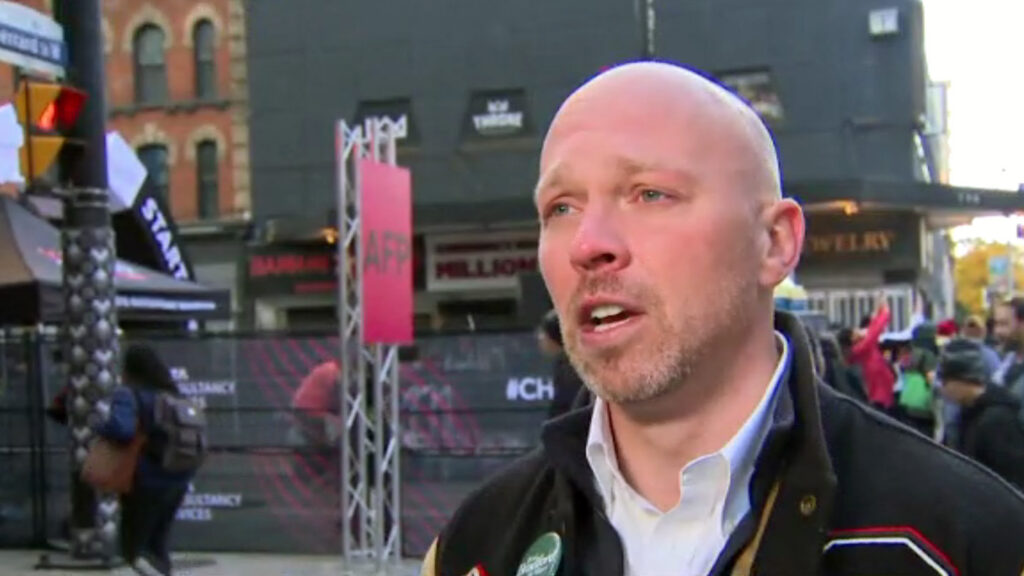
Mayoral candidate Brad Bradford highlighted the need for better event coordination in Toronto, especially during significant occurrences like the Toronto Waterfront Marathon. While acknowledging that such events are integral to the city's identity, he pointed out that the city’s transit arrangements need improvement. On the day of the marathon, spectators and participants were encouraged to use public transit, but the subway services did not start until 8 a.m., just as the event was kicking off. Bradford stressed that under his leadership, subway services will commence at 6 a.m. specifically for the Toronto Marathon.
Bradford's approach includes "common-sense measures" aimed at enhancing Toronto's transit efficiency. He plans to expand transit signal priority and signal preemption across the entire streetcar network, which includes the Crosstown LRT and Finch West LRT. According to Bradford, the experience on streets such as Richmond, Adelaide, and Dundas often makes it quicker for people to walk than to use streetcars, which he describes as functioning like "rolling stop signs."
Current mayor Olivia Chow has already implemented signal priority for LRT lines and aims to extend this initiative to the Spadina, King, and Queens Quay streetcar routes. In a statement, Chow questioned Bradford’s credibility regarding public transit, citing his past decisions to cut TTC services and raise fares as a reason for mistrust.
Bradford argues that the Toronto Transit Commission (TTC) and Metrolinx should publish their work schedules 30 days in advance to inform residents about transit options during major events. He has consistently advocated for the role of a "congestion relief commissioner." Despite the recent hiring of a traffic czar earlier this year, Bradford believes that little progress has been made in alleviating congestion, which he claims has increased compared to the previous year. He estimates that gridlock costs the Greater Toronto Area (GTA) approximately $40 million annually.
According to Bradford, the average Torontonian experiences about 100 hours of traffic disruption each year, a figure comparable to that of New York City. He emphasized the urgency for leadership capable of alleviating this congestion, stating, "Torontonians tell me all the time that Toronto feels stuck." Chow, on the other hand, emphasizes her focus on practical solutions, including the use of smart traffic lights that rely on real-time data, better coordination during construction and events, and an increase in the number of traffic agents tasked with clearing intersections.
During her tenure as mayor, Chow has allocated $3 million to quadruple the number of traffic agents working at the busiest intersections in downtown Toronto and has raised fines for violations such as “blocking the box” at critical intersections.
In addition to coordinating construction efforts by shifting them to off-peak or overnight hours, Bradford plans to install cameras and advanced technologies on city fleet vehicles. These innovations will allow for the scanning and detection of potholes, thus streamlining operations and reducing the reliance on 311 calls for maintenance issues. This multi-faceted approach aims to address the growing congestion problem that poses challenges for the city residents.