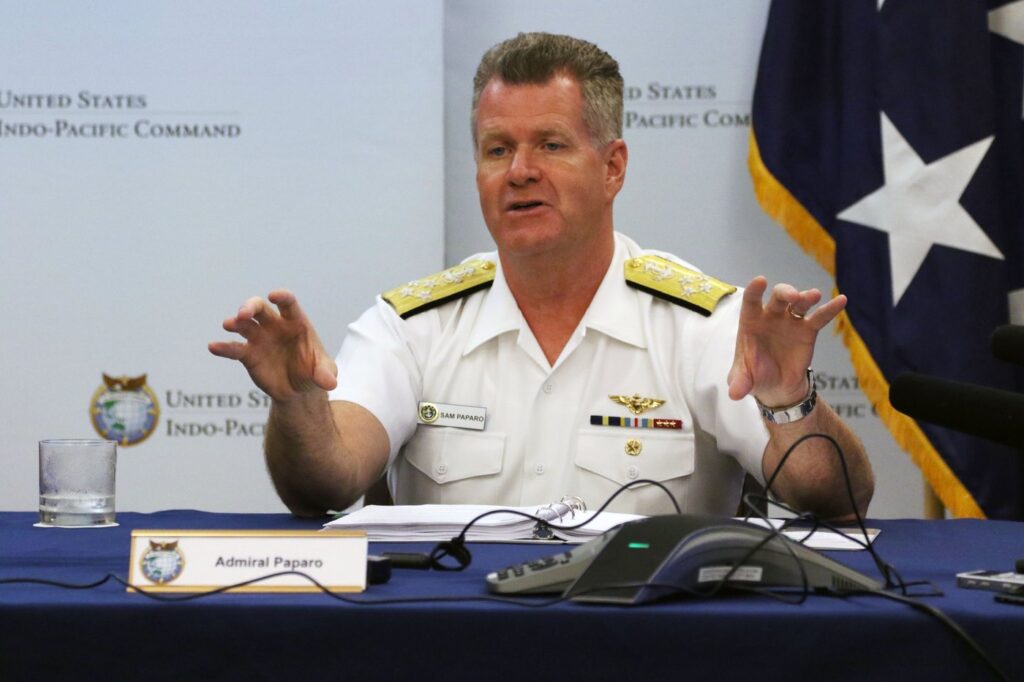
On Wednesday, Admiral Samuel Paparo, the head of U.S. Pacific Command, humorously indicated that the likelihood of the United States invading Canada was comparable to launching an attack on Mars. This remark came during a news conference held in Victoria, Canada, where he was questioned by a journalist about the possibility of such an order being given by President Donald Trump.
Admiral Paparo swiftly dismissed the inquiry, labeling it "absolutely and utterly preposterous." He affirmed his commitment to obey the orders of the commander-in-chief but remarked that the question was emotionally charged and unnecessary. "Would you ask me please, also, what my attack plans are for the Martians?" he quipped, underscoring the absurdity of the hypothetical scenario.
Emphasizing the nature of U.S.-Canada relations, Paparo reiterated that Canada is viewed as a "close" and "indispensable" partner to the United States. Despite ongoing tensions related to trade policies, particularly involving President Trump’s controversial suggestions regarding the annexation of Canada and converting it into a U.S. state, the admiral articulated a commitment to maintaining strong military ties between the two nations. While Trump has made comments about potential military action, he has also indicated that it is "highly unlikely" he would resort to such measures to annex Canada.
In his remarks, Admiral Paparo stressed that despite the political discourse surrounding trade and other issues, military relations remain robust and function without emotional influence. "While you do see political discussions take place, for military professionals, we're always ruthlessly focused on the mission ahead," he stated. This sentiment reflects a broader ethos of maintaining an apolitical military stance, which he asserted is common throughout the Indo-Pacific and globally, allowing military personnel to navigate the fluctuations of political dialogue effectively.
Paparo's visit to Victoria was in conjunction with the 28th annual Indo-Pacific chiefs of defence conference, which he was co-hosting with Canada’s Chief of Defence Staff, General Jennie Carignan. The conference highlighted the significance of military cooperation between the two countries amidst a backdrop of political challenges.
This event underscores the importance of maintaining military professionalism and collaboration, even in times of political uncertainty, as echoed by Admiral Paparo’s comments regarding the focus and commitment of military operations. The dialogue surrounding military strategy and international relations remains a critical component of both U.S. and Canadian defense policies, reinforcing their collaborative efforts in the face of diverse challenges.