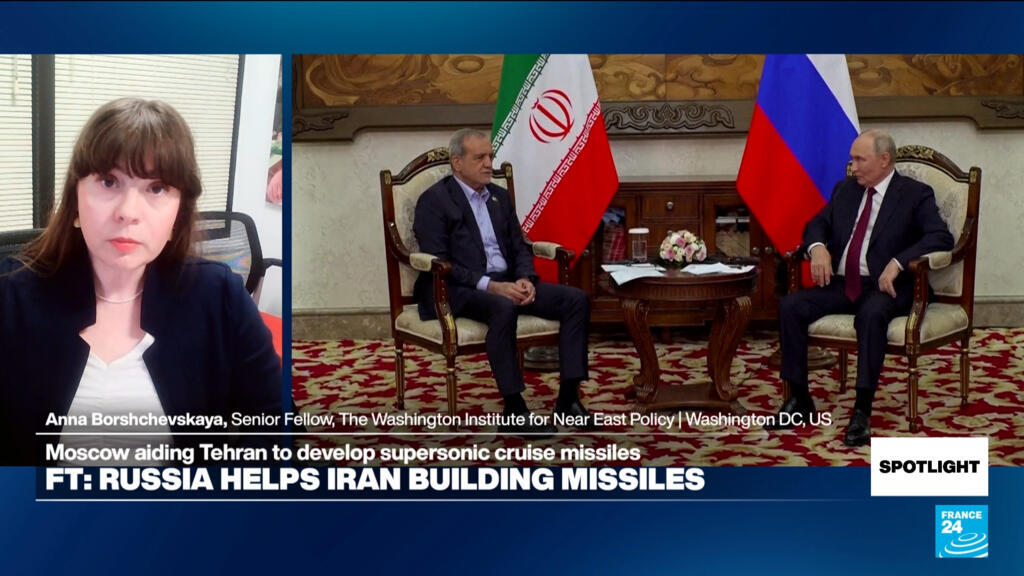
François Picard recently hosted Anna Borshchevskaya, a Senior Fellow at The Washington Institute, to discuss Russia's military support for Iran. Borshchevskaya posits that this relationship is not merely an arms transaction, but rather a tactical maneuver within a wider geopolitical landscape. She emphasizes that Moscow views its engagements with Ukraine, Iran, NATO, and the United States as interconnected fronts, reflecting a cohesive strategy aimed at reshaping global power dynamics.
Borshchevskaya argues that Russian President Vladimir Putin's aim is not to engage in direct military confrontation with the United States. Instead, his focus is on altering the strategic environment that surrounds U.S. interests. By supporting actors that are hostile to the United States, like Iran, Russia intends to create a more complex and challenging geopolitical setting for Washington. This tactic serves to increase the costs associated with any potential American or Israeli military responses and escalates the risks of direct conflict.
According to Borshchevskaya, this strategy of interconnectedness involves a series of calculated moves by Russia that align with its broader objective of enhancing its influence in regions traditionally under U.S. sway. By fortifying relationships with adversaries of the West, such as Iran, Russia is not only strengthening these actors but also destabilizing the existing balance of power. Such actions are intended to keep the United States preoccupied and uncertain about its own strategic objectives.
The senior fellow highlighted various instances where Russia's support for Iran comes into play. For instance, Russian military aid could provide Iran with advanced missile capabilities, which in turn could threaten U.S. interests in the Middle East. This scenario underscores a significant shift where Moscow is leveraging its alliances to chip away at U.S. hegemony and influence on the global stage.
Borshchevskaya also pointed out that Moscow’s strategy includes probing Western thresholds for retaliation. By testing how far it can push its relationships and military support without provoking a direct response from the U.S. or its allies, Russia aims to gauge the West’s resolve. These probes not only serve as practical tests of Western military and political responses but also function as signals intended to convey Russia’s willingness to engage in a more expansive geopolitical chess match.
Moreover, the implications of this strategy extend beyond Europe and the Middle East. Borshchevskaya warns that Russia's actions could embolden other adversaries of the United States, leading to a broader coalition that opposes U.S. foreign policy objectives. This rising bloc could reduce the effectiveness of U.S. military detterence and alter the strategic calculus for American policymakers in various regions.
In conclusion, Borshchevskaya’s analysis presents a troubling picture of the current geopolitical landscape, where Russia's support for Iran represents a calculated element of a larger strategic framework aimed at countering U.S. influence and military power worldwide. By intertwining the fates of various adversaries, Russia seeks to create a multifaceted challenge to American interests, with the potential for significantly disrupting established international norms and security arrangements.
```