CAIRO (AP) - The American military announced on Saturday that U.S. forces conducted strikes on three Iranian oil tankers following targeted ballistic missile attacks on Navy warships. This escalation has raised concerns among experts, especially after recent Iranian attacks on commercial shipping in the region.
The U.S. strikes took place one day after President Donald Trump attempted to downplay the tensions, referring to the conflict as "small potatoes." The situation marks a return to hostilities after six months of intermittent warfare that began with U.S. and Israeli strikes on Iran on February 28. Both nations have been engaged in inflicting military and economic damage on one another, with negotiations failing to produce any resolution.
The American military's statement indicated that an aircraft carrier and a destroyer evaded "multiple unprovoked Iranian attacks" while patrolling the area without any injuries to U.S. personnel reported. It was not specified when the Iranian missiles were launched. The U.S. asserted that two Iranian oil carriers were "permanently disabled," while a third, which was not carrying any cargo, was destroyed.
Following the U.S. strikes, Iran's state broadcaster reported that Iranian forces retaliated by targeting three oil tankers and three American vessels. This claim has not been independently verified. An Iranian military spokesperson warned that future U.S. strikes on Iranian shipping vessels would provoke even more severe responses.
The targeting of a U.S. aircraft carrier with a ballistic missile signals Iran’s growing willingness to take risks that it previously avoided, according to Danny Citrinowicz, an expert on Iran at Israel's Institute for National Security Studies. He suggested that the move portrays a significant shift in Iran's military posture.
Earlier, Iranian state media reported that four U.S. missiles had struck a tanker near Kharg Island, which serves as a crucial terminal for Iran's oil exports. This location has faced repeated attacks during the conflict, including U.S. strikes on military facilities in the area back in March.
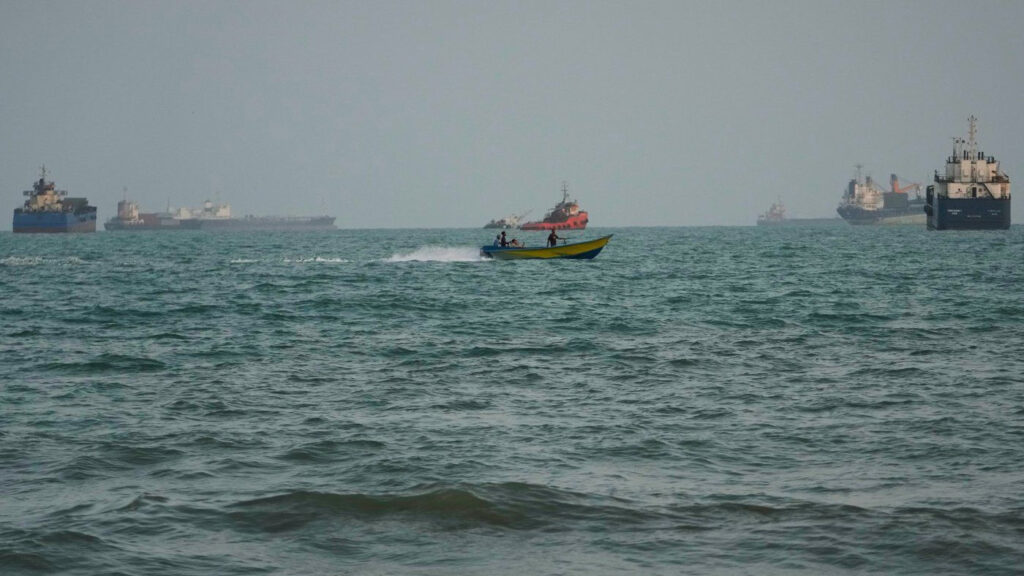
The U.S. confirmed that one tanker was hit near Kharg Island and another was struck close to Jask, situated east of the strategically important Strait of Hormuz. The unladen tanker was attacked in the Gulf of Oman, and its crew was instructed to evacuate the vessel. The U.S. released what it described as video footage showcasing the strikes.
In response to the situation, Adm. Brad Cooper, head of U.S. Central Command, emphasized that the U.S. would not hesitate to defend its forces and, if necessary, would dismantle Iran's limited oil fleet.
Iran's Foreign Ministry condemned the attacks, labeling them a war crime, and warned that the repercussions of ongoing U.S. aggression, including "economic warfare," would be borne by Washington and its allies.
As hostilities persist, the number of Iranian oil tankers that have been targeted remains uncertain. In early May, the U.S. military reported using "precision munitions" against two Iranian oil tankers that were both unladen.
This newest round of attacks marks a return to violence less than a week after a temporary lull, with the Strait of Hormuz and the surrounding Iranian communities again becoming points of contention. Recent U.S. bombardments in southern Iran resulted in at least five casualties, including a striking incident that hit a wedding celebration, leaving several civilians wounded.
Masoumeh Zarei, a 13-year-old girl who was injured during the attack, recounted her harrowing experience. She described her despair at missing the wedding celebration after being knocked unconscious by the blasts. Her friend, Kiana Karimi, a 14-year-old, also sustained injuries and noted the chaos caused by the explosions.
The Trump administration has adopted a dual-prong strategy in addressing the conflict through military responses alongside economic pressures targeting Iran's financial networks. U.S. Vice President JD Vance stated last Thursday that there would be no prospects for renewed talks as long as Iran continues its aggressive actions against shipping, despite major military operations ceasing in July.
Meanwhile, Iran's newly elected government, led by President Masoud Pezeshkian, advocates for a negotiated resolution to the conflict, despite indications from hardline factions within the leadership suggesting a long-term view of enduring sanctions.
Despite the ongoing U.S. blockade and pressure, Iran has adapted over the years to bypass sanctions, utilizing a shadow fleet to transport oil to international buyers, mitigating growing economic challenges. The discord over Iran's nuclear program served as a catalyst for the current conflict, which was meant to be addressed in negotiations that failed to materialize following a memorandum agreement in June.
With the U.S., Britain, France, and Germany now seeking to refer Iran to the U.N. Security Council for noncompliance with nuclear obligations, the strategic importance of the Strait of Hormuz remains a focal point in this ongoing conflict, with the U.S. military actively assisting ships navigating through the region amidst Iranian assertiveness in targeting vessels.