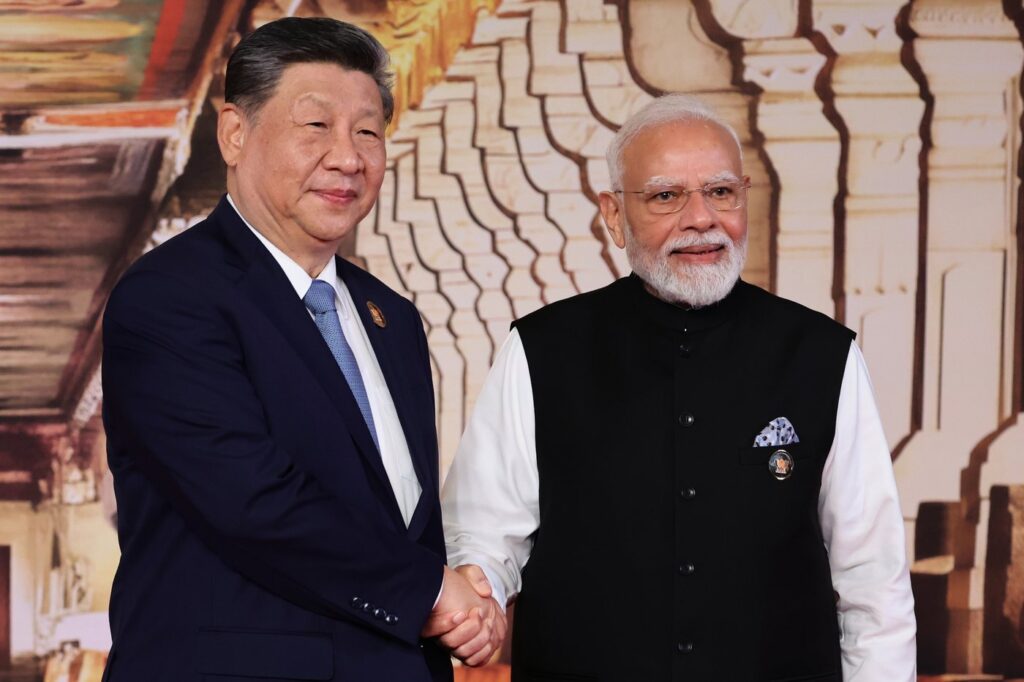
NEW DELHI (AP) – Indian Prime Minister Narendra Modi and Chinese President Xi Jinping met on Saturday, September 9, 2023, on the sidelines of the BRICS summit held in New Delhi. This meeting marks the latest attempt by the two rival nations to mend relations that have been strained due to a deadly border clash that occurred six years ago.
During the meeting, Xi emphasized that China has approached its relationship with India from a "strategic and long-term perspective." He called for both countries to leverage each other's strengths, provide mutual support, and pursue common development goals. Additionally, Xi advocated for "high-quality cooperation" and indicated that as significant members of the Global South, both nations should strive for a more multipolar world and contribute to global peace and stability.
According to China's official Xinhua News Agency, Xi highlighted the gradual resumption of institutional exchanges between China and India, along with an expansion in bilateral trade. He characterized China and India as partners rather than rivals and suggested that they represent mutual opportunities for development instead of threats to one another.
Modi expressed gratitude towards Xi for China's support in hosting the BRICS summit, which is set to be held in China next year. BRICS is an acronym for Brazil, Russia, India, China, and South Africa, the founding members of the group.
Modi stressed the importance of peace along the disputed border to foster broader ties. He urged both countries to adhere to existing agreements related to the boundary dispute. Following their discussion, the Indian foreign ministry released a statement reaffirming their commitment to finding a fair and mutually acceptable resolution to the ongoing border conflicts. Modi stated, "Differences should not become disputes," and emphasized the need for mutual respect, sensitivity, and interest from both sides.
The leaders also explored ways to enhance people-to-people connections and business relations while addressing issues of trade imbalances, supply chain challenges, and market access concerns, as noted in the statement.
This summit represents Xi's first visit to India since 2019 and exemplifies yet another cautious effort aimed at restoring warmth in relations six years after the deadly border clashes. The 2020 military confrontation resulted in the deaths of at least 20 Indian soldiers and four Chinese service members in the Ladakh region, leading to an extended standoff where both countries have maintained substantial military presence supported by artillery and airpower.
Despite some measures taken to alleviate tensions, significant mistrust persists between India and China. The two nuclear-armed nations continue to contest portions of their border, and India's considerable trade deficit with China, along with restrictions on Chinese investments and competing strategic interests in Asia, exacerbate relations. Furthermore, India has increased its military infrastructure along the disputed border, while China has also bolstered its defenses and construction activities on its side.
Xi's visit is anticipated to test whether the recent thaw in relations can evolve into a more substantial stabilization of ties. Since the Sino-Indian war in 1962, both countries have experienced significant economic growth; however, China's economy has significantly outpaced India's, leading to a large trade surplus in favor of China. This growing economic rivalry adds further complexity to their existing territorial and strategic disputes.
India has sought to take advantage of China's increasing labor costs and its strained relationships with Western powers to position itself as an alternative base for foreign manufacturers. Additionally, New Delhi has expressed strong opposition to China's multibillion-dollar Belt and Road Initiative, viewing it with suspicion. On the other hand, India's escalating strategic partnership with the United States raises apprehensions in Beijing, which perceives this alliance as an attempt to counter China's ascendancy.