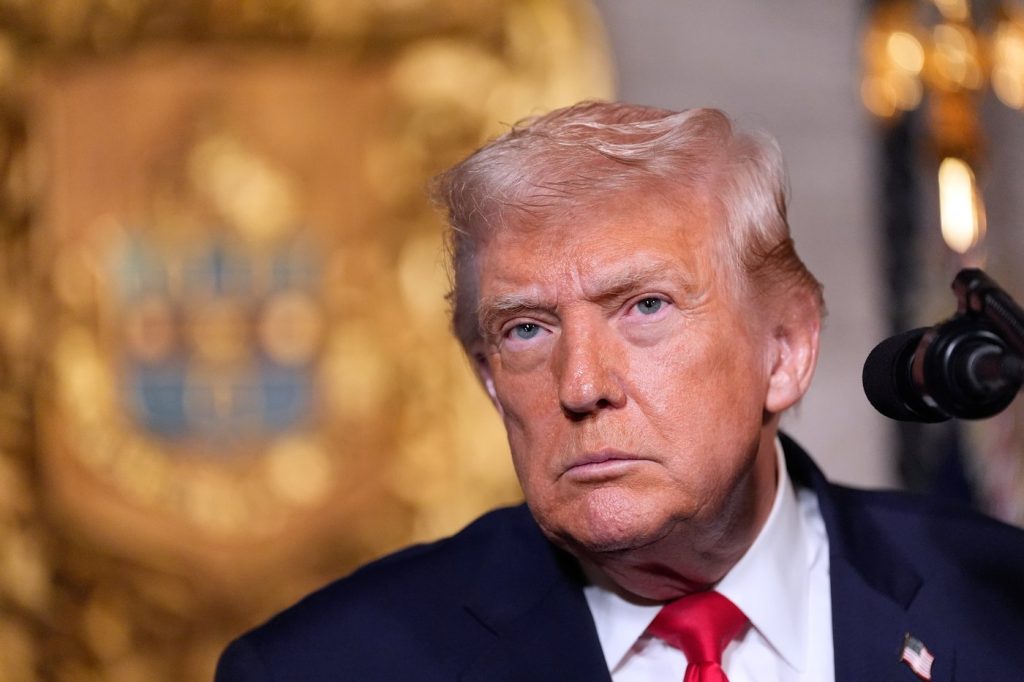
WEST PALM BEACH, Fla. (AP) - President Donald Trump announced on Christmas evening that the United States executed a "powerful and deadly" military strike against Islamic State forces in Nigeria, following weeks of criticism aimed at the West African nation's government for its failure to curb the persecution of Christians. In his social media post, Trump did not specify details regarding the operations or the damage inflicted by the airstrikes.
A Defense Department official, who requested anonymity, stated that the U.S. collaborated with Nigeria in planning and conducting the strikes, which received approval from the Nigerian government. The Ministry of Foreign Affairs of Nigeria confirmed this cooperation, emphasizing that the actions were in alignment with international law and highlighted mutual respect for sovereignty and shared commitments to security.
Trump emphasized that the airstrikes targeted Islamic State militants responsible for the "vicious killing" of innocent Christians. However, reports from residents and security analysts indicate that Nigeria's security crisis impacts both Christians, primarily in the southern regions, and Muslims, who predominantly reside in the north. Nigeria's Ministry of Foreign Affairs noted that terrorist violence against any group, whether Christians, Muslims, or others, contradicts the country's values and global peace.
Nigeria faces challenges from multiple armed groups, including the Islamic State West Africa Province, which is an offshoot of the Boko Haram extremist group, as well as the less well-known Lakurawa group active in northwest states. Security analysts suggest that the U.S. airstrikes may have targeted the Lakurawa group, which has become increasingly lethal, often attacking remote communities and security forces. A Nigerian security researcher noted that the Lakurawa group controls territories in States like Sokoto and Kebbi, worsened by the weak presence of state forces in high-risk areas.
In response to Trump's criticism about the government’s handling of extremist violence, Nigerian officials pointed out that individuals of various faiths have suffered due to attacks from extremist groups. Trump previously instructed the Pentagon to prepare for possible military action in Nigeria aimed at addressing the alleged persecution of Christians. Additionally, the State Department has implemented visa restrictions for Nigerians involved in the killings of Christians, and the U.S. designated Nigeria as a "country of particular concern" under the International Religious Freedom Act.
Trump stated that U.S. defense officials successfully executed "numerous perfect strikes" and asserted the commitment to preventing radical Islamic terrorism from flourishing. Nigeria has a population of approximately 220 million, divided almost evenly between Christians and Muslims, and has long struggled with insecurity from various fronts, including the Boko Haram extremist group.
Attacks in Nigeria are often driven by multiple motives, including religious extremism targeting both Christians and Muslims, violent clashes between farmers and herders over resources, communal conflicts, and ethnic disputes. In recent times, the U.S. military presence in Africa has decreased, with many military partnerships being either scaled down or terminated. Consequently, U.S. forces might need to be redeployed from other areas for any extensive military intervention in Nigeria.
Despite these challenges, Trump has maintained pressure on Nigeria as incidents of violence against schools and places of worship continue. Defense Secretary Pete Hegseth expressed on social media that the President made it clear that the killing of innocent Christians must cease, reaffirming the readiness of U.S. military forces and acknowledging the cooperation from the Nigerian government. Hegseth concluded his statement with a message of Christmas wishes, indicating ongoing efforts against extremism.