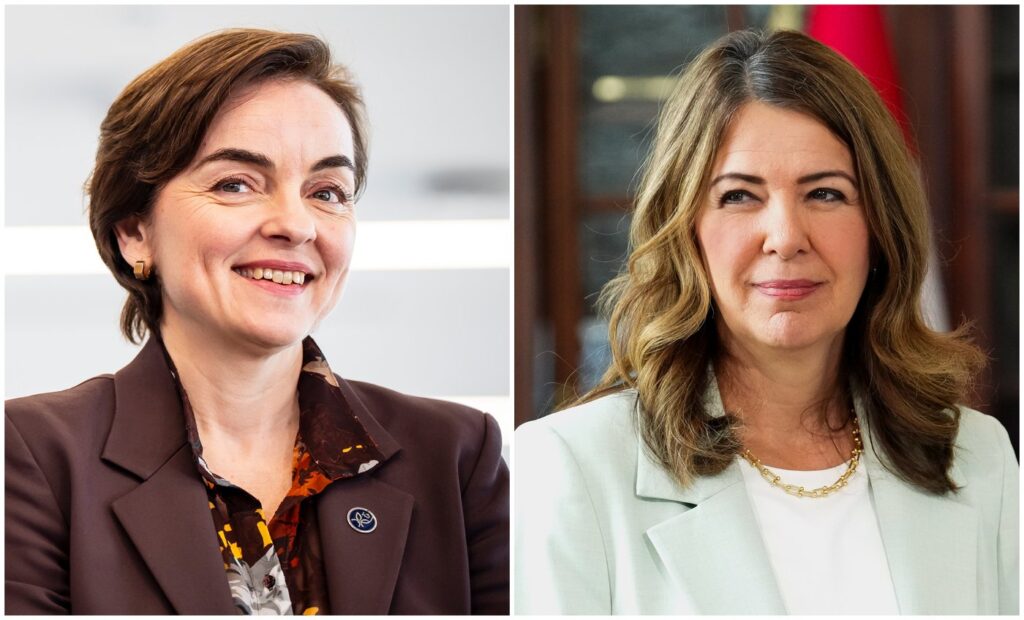
CALGARY – Alberta Premier Danielle Smith is set to meet with Quebec Premier Christine Fréchette in Quebec City this week, with discussions likely to encompass issues such as separatism and energy policies. The meetings are scheduled for Tuesday and Wednesday, and are expected to cover various topics including trade, investment, and provincial autonomy.
During an unrelated news conference in Calgary, Smith addressed the upcoming visit, noting her previous discussions with the former Quebec premier about developing Quebec's natural gas resources. She emphasized that such development could help Quebec achieve energy self-sufficiency from the United States and enhance its export capabilities, particularly to Europe. “I know that Madame Fréchette had talked about the potential for renewing that conversation,” Smith remarked on Monday.
Premier Smith has a history of advocating for Quebec to bolster its energy sector to generate more revenue, which could enable the province to strengthen its position within Canada's equalization program. This federally funded initiative allocates financial resources to provinces with lower revenues, such as Quebec, Manitoba, and the Atlantic provinces, allowing them to maintain comparable levels of services and tax rates to those of wealthier provinces like Alberta and Saskatchewan.
Smith has expressed that if Quebecers aspire to be robust and sovereign within a united Canada, it begins with the development of their own resources. "So if Quebecers want to be strong and sovereign within a united Canada, starting by developing their own resources is number 1," she stated prior to a speech in Montreal last fall. She further remarked, “I’d love to see Quebec develop a new revenue source so that they can reduce the amount of equalization they get.”
The topic of equalization payments has become contentious among separatists in Alberta, who feel a sense of grievance towards Eastern Canadian politicians who benefit from the program. Additionally, on October 19, Alberta will present several referendum questions to voters, including one related to separation. This inquiry will ask Albertans if they wish to remain part of Canada or initiate a legal process for a binding referendum on leaving the confederation.
Smith acknowledged the potential financial implications of separation, estimating that an independent Alberta might incur approximately $400 billion in transitional costs, coupled with annual expenses ranging from $25 billion to $50 billion. “All of our trade agreements would have to be renegotiated,” she explained, indicating that such a transition would lead to economic disruptions and likely tariffs on traded goods.
Quebec has a longstanding history of movements advocating for separation, making it plausible for discussions surrounding secession to arise between Smith and Fréchette. Additionally, they may explore the notion of greater provincial independence from the federal government. Smith noted, “I know that I’ve been inspired by Quebec on a number of different fronts in passing legislation, like the Provincial Priorities Act, and others, based on legislation that I saw Quebec had.”
While in Quebec, Smith does not intend to meet with Paul St-Pierre Plamondon, the leader of the Parti Québécois, which champions the cause of Quebec secession. However, despite the rising sentiment for separatism within their respective provinces, Smith and Fréchette share common goals in promoting greater independence for both Alberta and Quebec. “I think that we can have a strong partnership between Quebec and Alberta, not only on how we repair the country so it gets back to the way it was initially intended to run, but also on an energy corridor,” Smith articulated.
In addition to her meetings with Premier Fréchette, Smith is also expected to engage with various Quebec-based companies and industry associations during her visit.