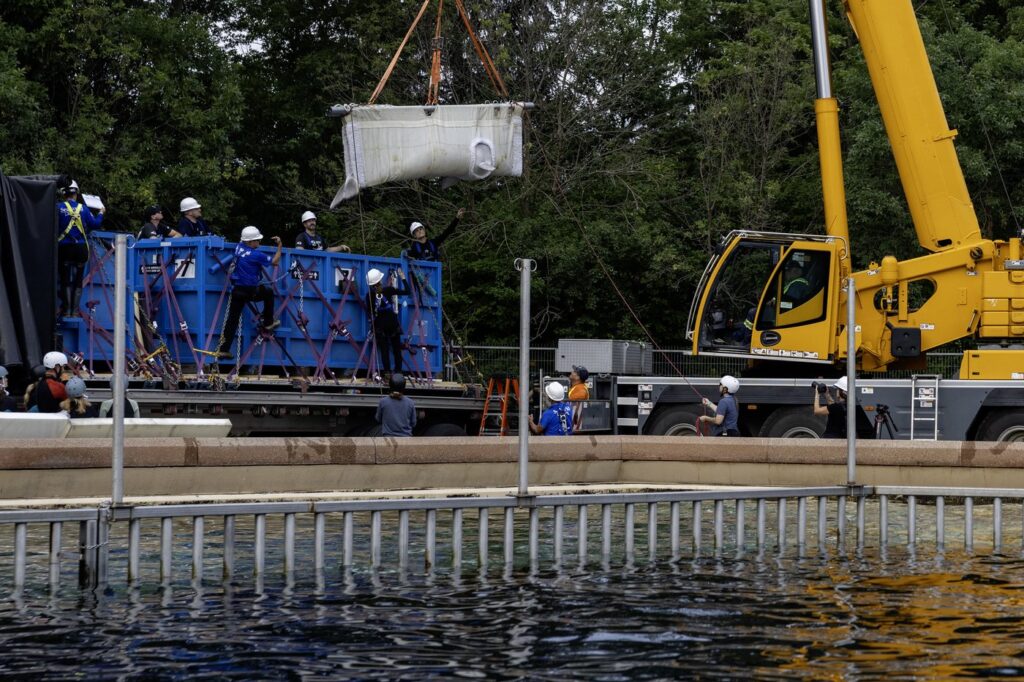
NIAGARA FALLS – A significant development in marine conservation occurred when six captive belugas from Canada successfully transitioned to their new habitats in the United States. This operation was part of a long and intricate process initiated by Marineland, in cooperation with a consortium of U.S. aquariums, which began on Monday afternoon at the now-closed Marineland amusement park in Niagara Falls, Ontario.
Marineland has been shuttered to the public since 2024 as it seeks to sell its extensive property located near the iconic Horseshoe Falls. Financial struggles have forced the facility to admit that it can no longer adequately care for its marine inhabitants. Prior to this transfer, Marineland harbored a total of 30 belugas and four dolphins, marking it as the largest collection of captive belugas globally and the last institution in Canada to hold captive whales and dolphins.
The belugas are set to relocate in stages to five marine parks across North America and beyond: the Shedd Aquarium in Chicago, SeaWorld San Antonio, another SeaWorld in San Diego, the Georgia Aquarium in Atlanta, and Oceanografic Valencia in Spain. The first batch of four female belugas—Sierra, Acadia, Osiris, and Lillooet—arrived at Shedd Aquarium during the early hours of Tuesday morning. The transportation process started with Sierra being lifted from her pool shortly after 4:30 p.m. on Monday, followed by the other belugas.
Two male belugas, Bertie Botts and Frankie, were secured into their tanks by 8 p.m. that same day. They were then transported by police-escorted convoy to Toronto Pearson International Airport, where they were loaded onto a cargo jet. While Bertie Botts and Frankie remained on board the plane, the female belugas were dropped off at Chicago before the pair continued to their new destination at SeaWorld in San Antonio, arriving later on Tuesday morning.
Andrew Burns, an adviser to Marineland, expressed relief that the move exceeded expectations, noting that the process of lifting the whales and transporting them incurred no significant problems. “The risk is always how the whales react, but that can be moderated by the conduct of the team,” Burns explained. His praise emphasized the professionalism of the staff involved in the transfer, noting that their experience helped alleviate potential stress for the animals.
According to the U.S. consortium, the belugas are adapting well to their new surroundings. Dr. Karisa Tang, the lead veterinarian at Shedd Aquarium, stated, “This moment marks the next chapter for these rescued belugas. Now that they are here, the full attention of our care and veterinary teams is on getting to know these whales and providing whatever supplemental support, treatment, and care we can to help them acclimate to their new home.”
Despite the successful relocations, Marineland has faced significant difficulties in recent years, including water quality issues that prompted the provincial government to mandate urgent repairs to the park's water system. The province had previously classified all marine mammals within Marineland as distressed. From 2019 to the present, twenty marine animals, which including nineteen belugas and one killer whale, along with one dolphin, have died under their care, according to internal government documents. Fortunately, there have been no recent deaths in the past year as the province acknowledged improvements in water quality after substantial investments by Marineland.
The initial departures ignited a mixture of emotions among former trainers. Kristy Burgess, a former staff member who was terminated in February 2025 following the euthanization of a young beluga named Eos, recalled her deep bond with Frankie. “I spent most of yesterday on and off crying because some of these whales I was incredibly close with, especially Frankie,” she reflected, emphasizing that, although she experienced a rocky start with Frankie, their relationship ultimately blossomed.
Phil Demers, another former employee and outspoken critic of Marineland, expressed concern about animal welfare and acknowledged the improvements in care that the belugas will receive at their new facilities. He reiterated the importance of this move, noting, “That said, I wish it would have been done a long time ago, but progress takes time, and it’s worth celebrating.”
Last year, Marineland attempted to sell all 30 belugas to Chimelong Ocean Kingdom in China, but the deal was blocked by Fisheries Minister Joanne Thompson, who cited concerns for the whales' best interests and compliance with a 2019 federal law banning marine mammal captivity. In response to the financial crisis, Marineland threatened to euthanize all remaining whales if emergency funding was not secured, leading to the eventual arrangement with the consortium of aquariums.
As of now, Marineland is making plans to have all remaining whales and dolphins relocated by the end of August, leaving 24 belugas and four dolphins still in their care.