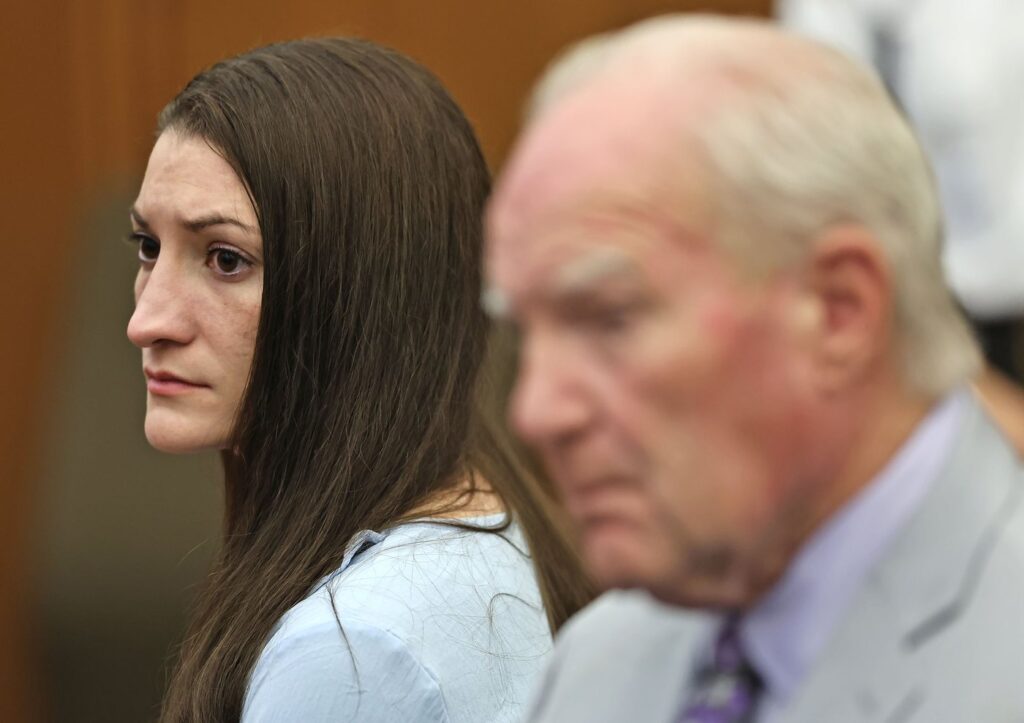
PLYMOUTH, Mass. (AP) - The jury in the Lindsay Clancy trial left the courtroom without a verdict on Thursday, concluding a dramatic sixth day of deliberations. The situation intensified when the jury’s foreperson sent a note to the judge indicating that a single juror was unwilling to adhere to the court's instructions regarding reasonable doubt.
While the specifics of the jury room discord remain undisclosed, it has become clear that one juror may be obstructing the collective decision on whether Clancy is criminally responsible for the deaths of her three children. The jury is scheduled to reconvene on Friday in hopes of reaching a consensus. Before adjourning, the judge rejected the defense's motion to remove one juror following heated exchanges among the parties involved.
Lindsay Clancy, 36, a former labor and delivery nurse, has admitted to strangling her children—Cora, 5, Dawson, 3, and Callan, 8 months—in the basement of their Plymouth home in 2023 before attempting to take her own life. Clancy's attorney argues that she was suffering from postpartum psychosis at the time of the killings, while prosecutors contend that she was aware of her actions when she committed the acts.
The trial, which has been livestreamed, has attracted significant media and public attention, filling the courtroom with spectators. The case has ignited public debate over maternal mental health issues and Clancy's culpability in light of her claimed mental state.
In recent deliberations, the jury has signaled its struggle to reach a verdict, indicating an impasse twice. On Thursday, the foreperson sent a note claiming that one juror was not adhering to the law regarding reasonable doubt. Judge William Sullivan addressed this note by questioning each juror individually in a private session before reiterating the legal standards they must follow during deliberations. The defense's request to dismiss the recalcitrant juror was firmly dismissed by the judge.
Attorney Kevin Reddington expressed concern that if the case resulted in a mistrial due to this one juror's refusal to follow the instructions, it would be a "real shame." He noted that the juror would be subjected to further questioning by the judge on Friday. Prosecutor Jennifer Sprague defended the judge's actions, stating that he made the right call in not taking further measures.
During this unusual turn of events, Clancy, who has been paralyzed from the waist down due to her suicide attempt, participated in a sidebar conversation with the judge, a first for her in the trial. Both her attorneys and the judge agreed that she had the right to be informed about developments in the proceedings.
Signs that the jury was struggling to reach a unanimous verdict became evident when the judge informed the courtroom that the jurors were at an impasse for the second time. Judge Sullivan advised the jurors not to compromise their beliefs merely to arrive at a verdict, encouraging them to consider differing viewpoints carefully.
If the jury ultimately cannot reach a decision, the judge may declare a mistrial. In such a case, the prosecution must choose whether to retry Clancy, drop the charges, or pursue a plea bargain. A guilty verdict could potentially lead to a conviction for murder or manslaughter. Conversely, if acquitted, Clancy might still be ordered into a mental health facility if deemed a danger to the public.
Throughout the trial, Clancy has received widespread letters of support from around the globe, showcasing the international attention her case has drawn. Medical professionals testified regarding Clancy's declining mental health leading up to the tragic incident, outlining her history with medication and psychiatric care.
Patrick Clancy, Lindsay's ex-husband, has publicly forgiven her, expressing his belief that she is a victim of illness rather than malice. He has provided interviews where he illustrates his perspective on the grave events and their aftermath.
The prosecution argues that Clancy's actions were premeditated, exemplified by the claim that she strategically sent her husband on errands to ensure he would be out of the house during the murders. In contrast, the defense emphasizes her mental state at the time, indicating that she was influenced by hallucinations suggesting acts of harm as a pathway to escape her suffering.