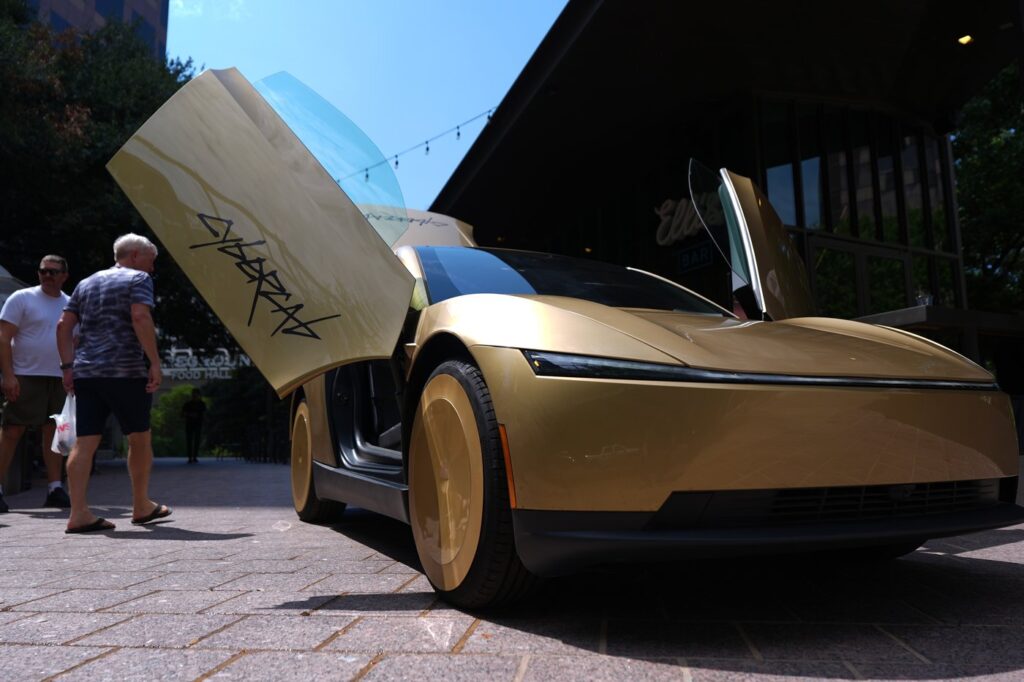
Elon Musk has launched dozens of self-driving Cybercabs without steering wheels or brake pedals on the streets of Austin, Texas. This move aims to shift public perception and encourage Americans to embrace the idea of rides with "no control." The distinctive gold-colored Teslas represent a bold step in the evolution of autonomous vehicles, as Tesla seeks to expand the service to other cities.
The launch of the Cybercabs comes amid a challenging period for Tesla, with shares experiencing a rise of over 5% on the day of the announcement, fueled by potential optimism surrounding the futuristic taxi service. This rollout follows a considerable decline in vehicle sales for the company, which has seen its market position slip as other competitors, like Waymo, take the lead in self-driving taxi deployment.
Tesla teased the absence of steering wheels and pedals on social media before the official launch, highlighting the revolutionary aspects of the Cybercab service. Musk shared images of a Cybercab hovering above the Austin skyline, describing it as "A Storm of Cybercabs" in a post.
While the exact timeline for the Cybercab service's wider rollout remains unclear, the urgency for Tesla is palpable as it trails behind self-driving leaders like Waymo in the number of vehicles deployed and completed trips. Unlike its competitors, which integrate additional technologies such as radar and lidar into their systems, Tesla relies solely on its camera-based approach. Musk's company must prove that its technology can safely traverse urban streets and avoid pedestrians to gain consumer trust.
Public sentiment surrounding driverless cars remains skeptical. A Pew Research Center survey from February revealed that seven in ten U.S. adults are "not too" or "not at all" comfortable riding in a driverless vehicle. Tesla’s stock faced considerable declines last year, attributed in part to Musk's controversial political involvement and strategy, leading to protests and boycotts targeting Tesla in various countries.
Despite previous operational experiences with its traditionally equipped self-driving "robotaxi" service launched in Austin in June of the previous year, the new Cybercabs have eliminated controls for passengers. The current system, which has expanded to five additional cities in Texas and Florida, previously carried safety drivers to intervene if needed. Now, with more than 200 of its "unsupervised" robotaxis, Tesla is positioned in the market, yet far behind Waymo, which operates over 4,000 cars across 14 cities.
In terms of consumer acceptance, the Pew survey highlighted that only 16% of U.S. adults felt "somewhat" comfortable entering a driverless car, and merely 7% expressed being "extremely" or "very" comfortable. A separate Gallup poll conducted in 2025 indicated a growing skepticism towards the safety of autonomous vehicles, with more people favoring human-operated cars over those that are fully driverless.
The question remains whether Musk is the ideal figure to encourage the American public to trust vehicles devoid of human controls. A January Pew Research poll indicated that nearly 60% of U.S. adults held an unfavorable view of Musk. Nonetheless, he envisions the capability to implement full self-driving software across hundreds of thousands of Teslas via software updates, permitting Tesla owners to use their cars as taxis when not in personal use.
However, regulatory bodies in both the U.S. and Europe have indicated that further demonstrations of safety are necessary before such widespread acceptance can occur. In Europe, Tesla has not yet secured approval for its partial self-driving software in most countries, while the U.S. has seen multiple investigations into its existing technology, particularly surrounding incidents involving crashes, including a fatality. These probes suggest that the road to regulatory approval and public acceptance will be complex and challenging for Tesla.
Despite the advancements in technology, the future of Tesla’s Cybercab service will depend heavily on public perception and regulatory compliance as the company seeks to revolutionize urban transportation.