The U.S. military has dismissed accusations from Iran that it struck an uncrewed American military vessel in the Strait of Hormuz, labeling the claim as a "total lie." In response, an Iranian official announced plans to establish an "exclusion zone" outside the Strait aimed at vessels that Iran believes are attempting to transit the strategic waterway.
Iran's state media claimed that a U.S. vessel was encroaching on an area deemed restricted by Tehran. However, Captain Tim Hawkins, a spokesperson for U.S. Central Command, refuted the allegation. The assertion emerged just a day after the United States targeted Iranian oil tankers in retaliation for ballistic missile attacks launched by Iran on U.S. Navy warships. This back-and-forth escalation follows a brief period of reduced hostilities.
Military conflict in the region reignited on February 28, 2023, with U.S. and Israeli attacks on Iran. Ceasefire negotiations failed to yield results, and both sides have engaged in ongoing hostilities aimed at inflicting military and economic damage on one another. Iranian Parliament Speaker Mohammad Bagher Qalibaf has warned that the era of "proportionate responses" is over, indicating that Iran's retaliation will be "faster, heavier, and more painful."
In light of recent tensions, Mohsen Rezaei, the new head of Iran’s Supreme National Security Council, indicated that the proposed exclusion zone will extend from the line of a U.S. naval blockade into the Strait of Hormuz and beyond into the Persian Gulf. This announcement follows heightened concerns among experts regarding the potential escalation of military actions, particularly as Iranian missile launches increasingly target commercial shipping.
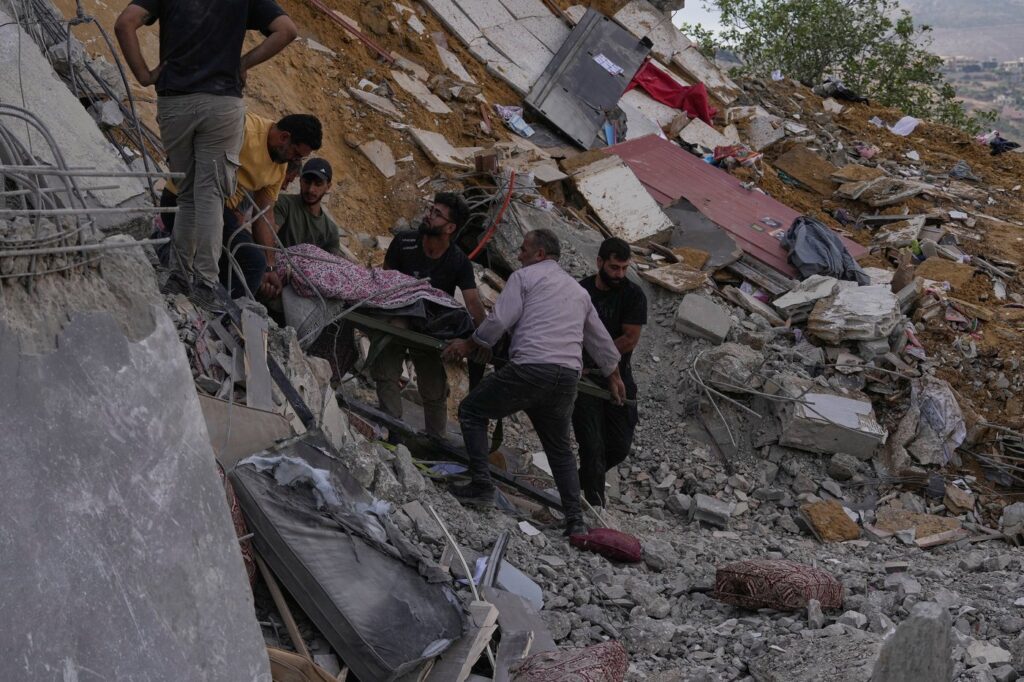
Meanwhile, Israeli airstrikes in southern Lebanon resulted in the deaths of at least seven individuals and the destruction of a vacant hospital. These strikes targeted the village of Arabsalim, killing two people, along with additional casualties in Nabatiyeh al-Fawqa, where two others died near a strategic hill that military sources claim they have now secured. A drone strike on a parking lot in Nabatiyeh al-Tahta claimed the lives of three more. At least 20 individuals sustained injuries, among them three children and five women. Israel stated its military actions were a response to a drone attack by Hezbollah on its troops in southern Lebanon.
The ongoing conflict saw low-level skirmishes and continued Israeli strikes in Lebanon, despite a ceasefire that had been in effect with Hezbollah for over two months. In Gaza, a mass funeral was held for more than 110 Palestinians who died during the ongoing hostilities, including around 70 children. The bodies were extracted from the Zeitoun neighborhood, with emotionally charged scenes witnessed during the mourning process.
The remnants of the war have seen over 73,650 Palestinians reported killed since its onset, according to Gaza's Health Ministry, which operates under Hamas. Ministry records are generally considered reliable by U.N. agencies and international organizations but do not specify the breakdown of civilian and militant deaths.
Jared Kushner, President Donald Trump's son-in-law, has defended the stalled peace talks regarding Gaza, describing it as a "dystopian place for a long time." While addressing political issues in Israel, Kushner acknowledged the complexities brought on by an upcoming election set for October 27, 2023.
In another incident, an Israeli strike targeted a civilian vehicle in Gaza City, resulting in the deaths of a father and daughter and injuring at least six others. The Israeli military stated it aimed at a "terrorist" within Gaza City. Since the resumption of hostilities following the ceasefire agreement with Hamas, at least 1,344 Palestinians have reportedly been killed, as Israel emphasizes targeting militants while responding to ceasefire violations.
In a separate development, foreign ministers from several Muslim nations, including Egypt and Saudi Arabia, condemned Israeli proposals that aim to evacuate Palestinians from Gaza, asserting that such actions violate international law and threaten the establishment of a future Palestinian state. Statements from Israeli officials, such as national security minister Itamar Ben-Gvir, who suggested facilitating migrations from Gaza, have drawn significant international criticism for being inflammatory.